Reading in English. Use the language switcher in the header to change.
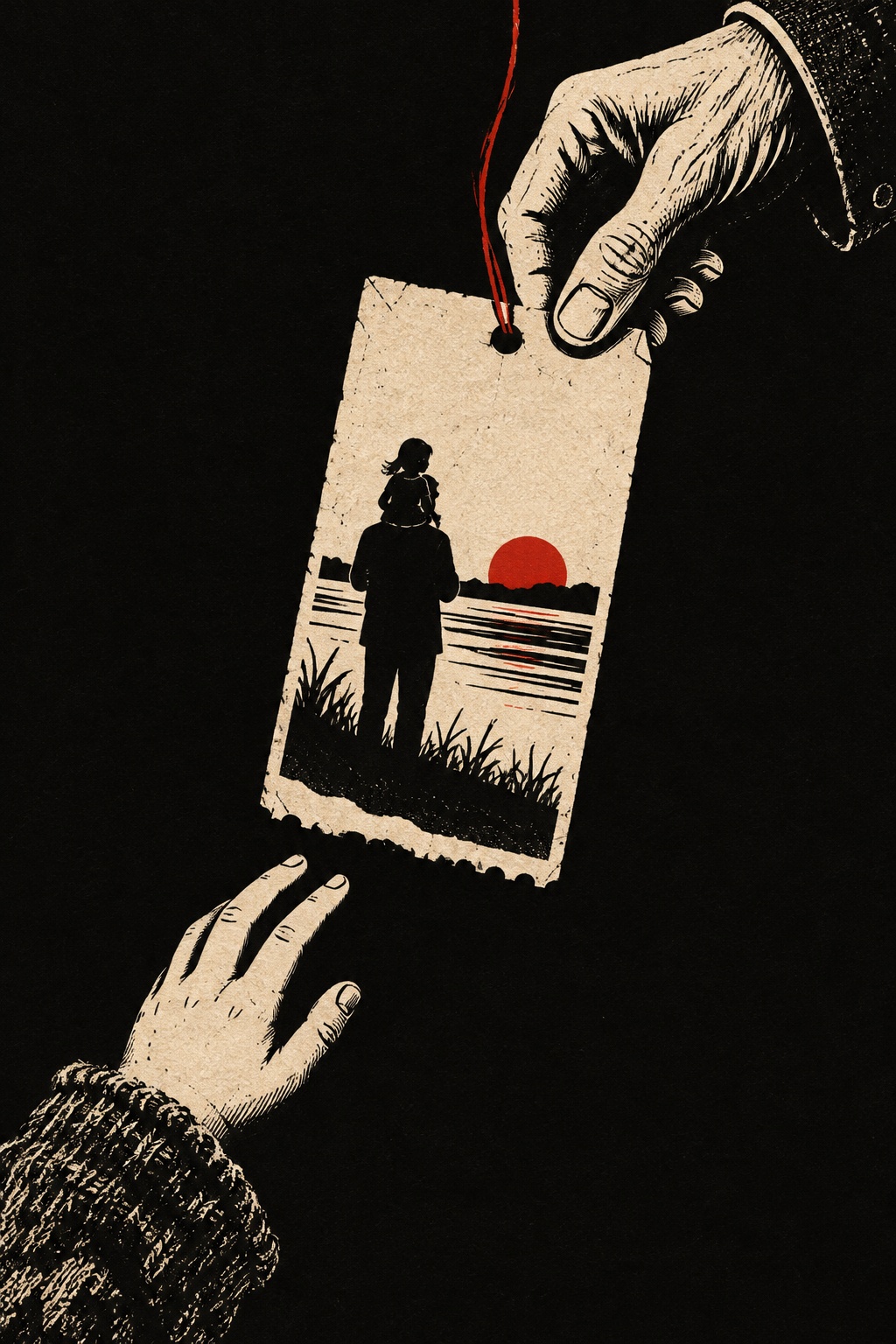
That winter, Hana's house began to empty a little at a time, like a song sung more and more softly. First went her father's coat, which had hung on its hook by the door since the day they buried him. Then the good wall clock, which left behind a pale square on the whitewash, where it had once counted out their time. Then the copper pot, the hallway mirror, and the two chairs that no one sat in anymore. Her mother sewed for other people at night, and the sewing machine rattled past midnight like a heart that could find no rest. But the sewing was never enough for bread, firewood, and rent all at once, and that year the winter was long. Hana knew where the things had gone. What she could not work out was where the bread came from, now that there was nothing left in the house to sell. And yet every dawn her mother came home with a warm loaf under her arm and a look that had stayed somewhere else. And something else, which Hana noticed later than the bread: her mother no longer hummed the song. It was her father's song, a melody without words that he whistled while he shaved, while he climbed the stairs, while he held Hana on his lap before sleep. After he died, her mother had kept it alive by humming it over the sewing machine, at the sink, in the dark. Now all that remained in its place was the rattle of the machine and the silence between two stitches. One morning, Hana saw her mother secretly slip a scrap of paper into the tea tin, the tin with the faded flowers that no one opened anymore, because they had not bought tea since autumn. Hana waited until her mother fell asleep, then pried up the lid with her fingernails, slowly, so it would not creak. Inside were dozens of slips, folded with care, each with a number and a few words written in a slanted, unfamiliar hand. At the top of each was stamped the name of a shop at the end of Narrow Street, where Hana had always been told not to go. The whole town knew about that shop, but no one ever mentioned it, the way no one mentions debts and illnesses. They did not take coats there, or clocks, or copper pots. There they took memories in pawn, and only happy ones, because for sad ones, it was said, nobody would give a penny. It was said that you only had to tell the keeper your memory, from beginning to end, and when you finished it was his, and all you had left was the knowledge that you had told him something. Hana laid the slips out on the table by number, from oldest to newest, and began to read. The first said: a blue bicycle, a downhill road, wind in the hair. The second: a mother braiding her daughter's hair beside the stove. Hana did not know those memories, but she understood what they were: her mother's childhood, sold piece by piece, like the chairs. Then the childhood ran out. And every slip that came after it was about her father. Among them, a spring wedding, in the rain. The first winter in this house, with one blanket for two. A man holding a newborn in his arms and crying without hiding it. Hana understood, without anyone telling her, that the newborn was herself. It was not that her mother had chosen her husband over her other memories. It was simply that after him, she had nothing happy left to pawn. The first slip about her father, pawned before all the others, bore the number 214. On it was written: a summer evening by the river, a song. Below, in red ink, was the deadline: Sunday. It was Thursday. The shop was so small it seemed to have been squeezed between two houses, with a dusty window and a bell above the door that did not ring when Hana stepped inside. Inside there were no shelves, no goods, no glass cases, only a table, two chairs, and a thick ledger lying open in the middle. The old man behind the table looked up and gazed at her as if he had been expecting her for a long time. He had soft, pale eyes, like the windows of a house where no one lives anymore. Hana set slip 214 on the table and told him she had come to take it back. The old man knew it at once, without so much as a glance at the number. "The river and the song," he said softly, and for a moment his face lit up like that of someone remembering something of his own. He did not try to lie to her. He told her that every memory told to him became his for as long as it lay in pawn, and forever if no one came back for it, and that at night he lived it, alone, as though he had been there himself. That was how he had lived the wedding in the rain, the winter with one blanket, the night Hana was born. He told her he had loved her father without ever knowing him, and that he had loved the two of them as well, mother and daughter, as if they were his own family. "But don't you have memories of your own?" Hana asked. The old man smiled, and it was the saddest smile Hana had ever seen. "I had them once, but I pawned them here when I was young and hungry," he said, touching the ledger. He did not say who had kept the shop in those days, and Hana did not ask. Then he told her the price. A happy memory could be redeemed only with a happy memory of equal weight, and for the river and the song she would need her own memories of her father. Hana thought of the evenings when he had held her on his lap. She thought it was fair: a song for a song. She opened her mouth to begin. The old man raised his hand, slowly, and asked whether she was sure her mother really wanted them back. "Not everyone comes here only for bread," he said. Hana was left without a word, her mouth still open. In the silence of the shop she remembered her father climbing the stairs and whistling so loudly the whole neighborhood could hear. He had never kept the song to himself. He had sung it to her mother, he had sung it to her, he had sung it to the neighbors, the trees, and the river, and the song had never grown any smaller, quite the opposite. Hana looked at the thick ledger, at the slips, at this shop where everything given was lost. Then she thought of her father, who had given his song away a thousand times and had never once lost it. She closed her mouth. Then she stood up, said goodbye to the old man, and left without paying anything. The bell above the door did not ring this time either. That night the sewing machine fell silent earlier than usual, because Hana took her mother by the hand and sat her down beside her, near the stove. She said nothing about the tea tin. She said only that she wanted to tell her something. Then she told her about a summer evening by the river, the way she remembered it, through the eyes of the child she had been then. She told her about water so cold it stung her feet, about her father's sleeves soaked to the elbow, about the flat stone he had thrown that skipped five times across the water. She told her how the sun had sunk behind the hill and how her father, carrying her on his shoulders, had begun to whistle. Her mother listened without moving. Hana saw in her eyes that the evening was no longer there, that its place was empty, like the pale square on the wall. But her mother listened, and listened the way one listens to a tale one seems to have known once. Then Hana began to hum the song. At first she hummed it badly, in her thin voice, stumbling over a note, because she had never sung it aloud. At the third note, her mother's lips moved. By the fourth, her mother was humming with her. She hummed and wept at the same time, without hiding it, the way someone weeps when something comes back that they did not even know they had lost. It was not her memory but Hana's; the man in it, though, was the same. Perhaps this way it weighed less. They both fell asleep by the stove, and the song stayed on their lips like breath on cold glass. On Sunday the deadline passed. Slip 214 stayed in Hana's pocket, a scrap of paper worth nothing now, and the river and the song stayed with the old man forever. The bread on the table was smaller now, bought only with sewing money, but her mother hummed the song as she sliced it. A few days later, Hana walked down Narrow Street and saw the old man behind the dusty glass, alone, the ledger open in front of him. He carried a thousand memories inside him and had no one to share them with. Hana stood for a moment at the door. Then she went in, sat in the chair across from him, and before he could say anything, told him she had not come to pawn anything. She had come only to tell him a memory, for free. It was the newest memory she had: a kitchen at night, a crackling stove, two voices humming the same wordless song. The old man listened with his eyes closed. When she finished, he wrote nothing in the ledger. Hana stood and opened the door, and the bell above it rang for the first time. The memory was still hers, whole and warm, like bread under her arm. She had gone only a few steps when, from the shop behind her, she heard, very faintly, someone trying to whistle the song.