Reading in English. Use the language switcher in the header to change.
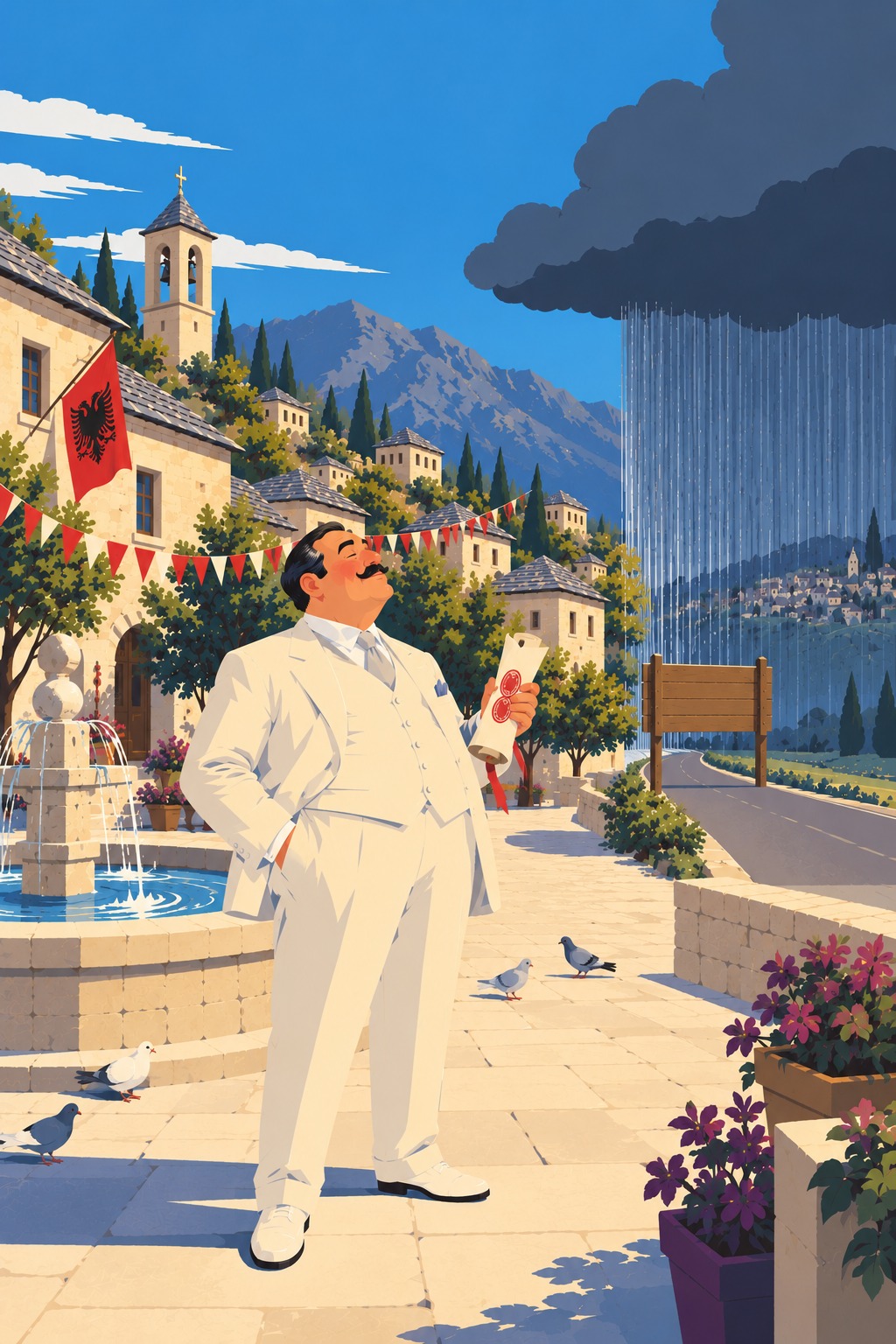
In the small town of Ujëbardhë, the rain had always been polite. It never fell on a wedding. It waited patiently until the women had taken the washing off the lines. And when it fell at night, it fell so softly that the children slept better. The town lived on it: its fountain, its fig trees, and the river where carpets were washed. Mayor Fatbardh loved three things: white suits, big stamps and his new square. The square was paved with white marble, so smooth that the pigeons slid across it. On Saturday the town would hold its festival, and Fatbardh would open the square with a long speech. But on Thursday evening, the sky over the mountains grew heavy as a wet carpet. Fatbardh watched it from the town hall window and pressed his lips together. Rain on his speech, on his suit, on his marble? He took his whitest sheet of paper and wrote: "Rain is forbidden in Ujëbardhë until further notice." He pressed two stamps on it, one on top of the other, because one stamp seemed too little. In the morning, people found the decree nailed to the town hall door and laughed behind their hands. "Next he'll be taxing the rain," said the baker. Only Nana Lume, who sold figs at the corner of the square, did not laugh. She read the decree twice, her lips moving without a sound, and shook her head. On Saturday the clouds arrived on time, the way good guests always do. They stopped at the town sign, as if before a gate. They stayed there for a while, grey and heavy, as if they were reading something. Then, without a sound, they turned aside and went around the town at a distance. The festival was perfect. The sun shone on the marble, the flags fluttered, and Fatbardh's speech lasted an hour and twenty minutes. Nobody got wet, except those who wept from boredom. But on Sunday the rain did not come, nor on Monday, nor all the following week. In the next village it rained twice as hard, up to the town sign and not one step farther. Children ran to the line on the road, put a hand into the rain and pulled it back wet. The fountain in the square coughed once each morning, then stayed silent all day. The figs wrinkled like old men's fingers. The river shrank so far that it set its stones out in the sun, white and surprised. People no longer laughed behind their hands. Fatbardh wrote a new decree: "Rain is permitted again in Ujëbardhë." He nailed it to the door with four nails and waited. The clouds passed overhead, polite as ever, but they no longer stopped at the sign to read. Then he wrote another, in golden letters and with the biggest stamp in the town hall. The clouds did not read that one either. One evening, Fatbardh walked down to the square and sat beside Nana Lume, on the empty fig crates. "It won't listen to me," he said. "It listened to you perfectly well," said the old woman. "You told it to leave, and it left." "But you never asked it to come back." "A polite guest doesn't come back for a stamp, only for an invitation." That night, Fatbardh sat down to write a letter of apology. The first began with "Dear citizens" and ran to three pages. The second had more stamps than words. The third came out so short that he was embarrassed to read it aloud. "Dear rain, I was rude, and I am sorry," the letter said. "Come whenever you like." This time he did not nail it to the door. He folded it in half and, while the town slept, left it on the dry rim of the fountain. At dawn, Fatbardh stood alone in the white square, his umbrella open under a clear sky. At the town sign, a small grey cloud stopped, as if it were hesitating. Then it drifted slowly closer, over the roofs, over the fountain, over the marble square. The first drop fell on Fatbardh's umbrella, lightly, like a guest who knocks before coming in.