Reading in English. Use the language switcher in the header to change.
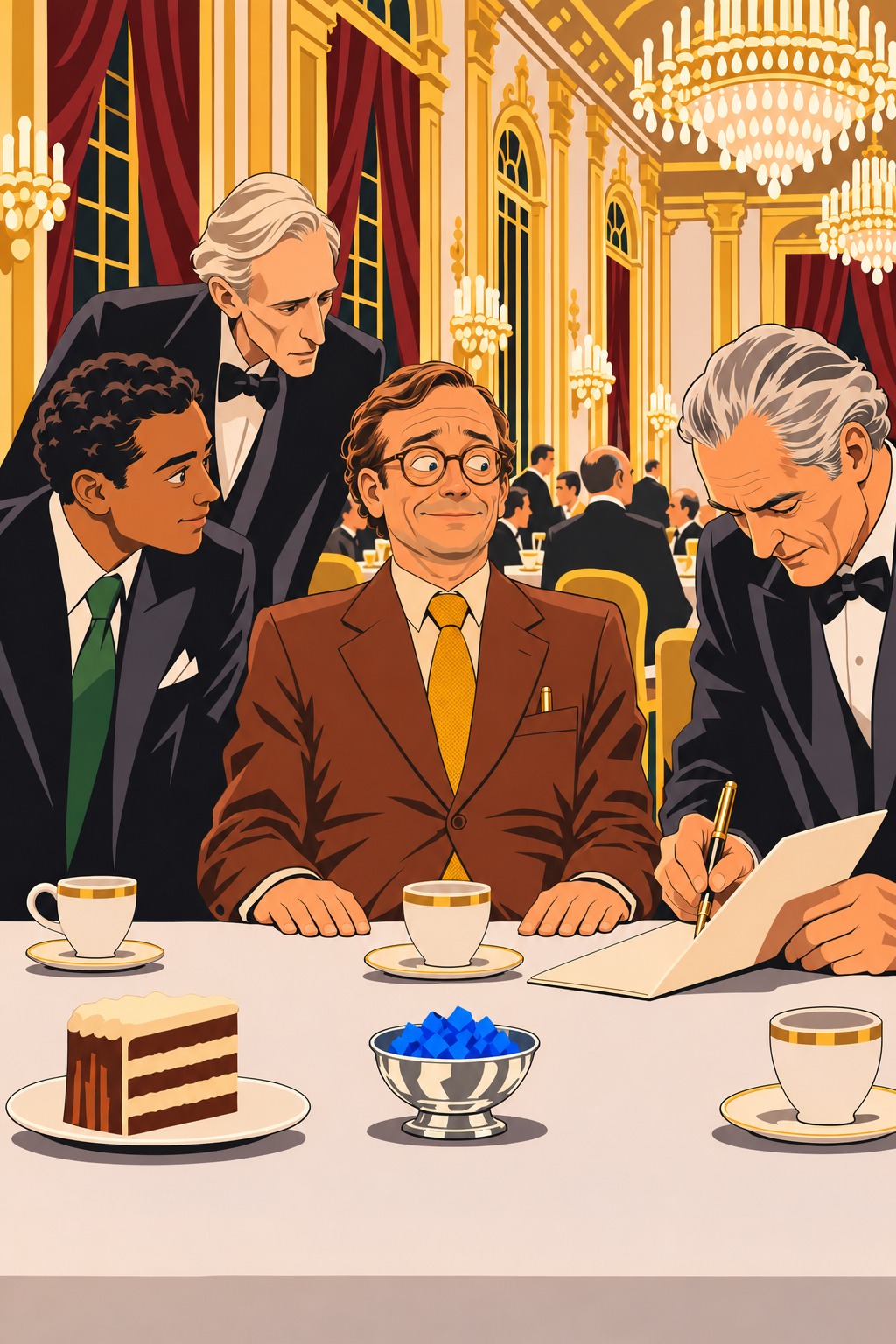
On Friday afternoon, Viktor Brenner was explaining to his oldest pupils what makes a country a country. On the blackboard he wrote three words, in the tidy hand that only geography teachers have: territory, population, government. Then, a little lower and more carefully, he added a fourth: recognition. "Some lawyers say a state exists only when other states agree that it exists," he said. In the front row, Greta raised her hand with the determination other people only show when collecting debts. "So if enough important people pretend a country exists, then it exists?" "Don't be silly," said Viktor, and gave her homework. In the staff room, in his pigeonhole, lay the envelope he had been ignoring all week: thick, cream-coloured, with the crest of the Foreign Ministry. Inside was an invitation to that evening's reception at the Hofburg, addressed to "Mr Viktor Brenner, Cultural Attaché". The ministry had two Viktor Brenners in its files, and a tired clerk had chosen the wrong one. Viktor had known all week that he ought to send the invitation back. But he had only ever seen the Hofburg on postcards, and the whole of Vienna talked about the buffet at those receptions. So at eight o'clock, in the suit from his brother's wedding, he climbed the marble stairs where the Congress of Vienna had once danced. The hall was full of ambassadors, of languages, and of the soft noise important people make when they talk about nothing. Viktor had only just picked up his first glass when the ambassador of Brazil stopped beside him. He was a tall man with silver hair and the smile of someone who has shaken hands with three presidents. He looked Viktor up and down and politely asked which country he represented. Viktor opened his mouth to tell him the truth. Then he saw the guard at the door, the buffet that was just being laid out, and a plate of prawns that passed him like a promise. "Varnelia," he said. He said it so naturally that he surprised even himself. The Brazilian ambassador did not hesitate for a moment. "Of course," he said, nodding slowly. "Lovely in spring." In that moment, Viktor understood the first rule of that hall. Nobody here would ever admit to never having heard of a country. It was 1974, new states were being born every year, and for a diplomat, looking ignorant was worse than lying. Within a quarter of an hour, Varnelia had acquired a capital, two lakes and a population of eight hundred thousand. Viktor had taught geography for twenty years, so he knew exactly how a believable country is built. When asked about exports, he answered without thinking: accordions, and a blue salt found only in the lakes of the north. The Danish trade attaché, a round man in spectacles, turned towards him like a hunting dog that has caught the scent of a bird. "Blue salt," he repeated. "Denmark has always loved salt." Before Viktor could say anything, the Dane had already asked for prices, quantities and the address of the embassy. Viktor gave him the address of the school, because it was the only one that came to mind. Just then a slight young man in a very new tie came over, the ambassador of a state that had been independent for eleven months. Like everyone else, he did not want to look ignorant, but he had one reason more. His own country was so new that he still had to explain it himself. He shook Viktor's hand with both of his and called Varnelia "our dear neighbour to the north". Viktor, who had invented Varnelia twenty minutes earlier, had not known it had neighbours. When the young ambassador asked about the border, Viktor named the first river that came into his head, the Selna. "Exactly, the Selna," said the ambassador, his eyes shining, "the river that unites us." Two glasses later, the Selna no longer united them. The young ambassador insisted that the left bank had belonged to his people since his grandfathers' time, and Viktor, to his own astonishment, disputed it with all his heart. A country born that evening already had a border dispute, and this, strangely, made it even more real. The protocol officer, a man with a list in one hand and panic in the other, moved Viktor to the head table. He could not find Varnelia on his list, but he did not dare to ask either. Dessert arrived at ten, a cake with more layers than the Congress of Vienna. Over the cake, the Brazilian ambassador proposed a treaty of friendship. The Danish ambassador, hastily summoned by his attaché, added an article on salt, the young ambassador added an article on the Selna, and since there was no paper, everything was written on the back of a menu. Three ambassadors signed it with gold fountain pens, with the same signatures they put on real treaties. Then they passed the menu to Viktor. Viktor signed it too, and his hand trembled less than his conscience. With the coffee, he decided to put an end to the game. He stood, tapped his spoon gently against his cup, and said he had a confession to make. "Excellencies," he said, "Varnelia does not exist." A long silence fell over the table. Then the Brazilian ambassador laughed, patted the table with his palm and turned to the others. "Brilliant," he said. "He is raising the price." The Danish attaché, alarmed, doubled his order of salt. The more Viktor insisted that his country did not exist, the more they admired him as a negotiator. He walked home through the fine November rain, with the folded menu in the inside pocket of his jacket. He could not bring himself to throw it away, though he could not have said why he was keeping it. On Monday morning, an embassy driver brought a letter to the school. The envelope bore the crest of the Kingdom of Denmark and was addressed to "His Excellency, the Ambassador of Varnelia". Inside was an official order for two tonnes of blue salt, payment in advance. The world had begun to answer. Viktor walked into the classroom, stopped in front of the big map of the world and looked at it for a long time, as if he were seeing it for the first time. Then he picked up a pencil. Very small, between two real countries, he drew a border. From the front row, Greta asked, "Herr Professor, is that a real country?" Viktor looked once more at the thin pencil line. "Three ambassadors think so," he said. And he went on with the lesson, leaving the border where it was.